

What the Green Auto Securitisation project delivered and what comes next
Building on three years of research into green auto securitisation
Over the past three years, European DataWarehouse (EDW) has collaborated with the Leibniz Institute for Financial Research SAFE on the Green Auto Securitisation (GAS) project, a publicly funded research initiative focused on improving how environmental performance is measured in European auto securitisation markets.
In earlier articles, we set out the broader context for this work and followed its progress. These included Our ESG Approach, which outlined EDW’s role in supporting sustainable finance through data and market infrastructure, Green Auto Securitisation Advocates Specific Measures for the Reduction of Vehicle Emissions, which presented policy‑relevant recommendations from the project, and A Year in Review: European DataWarehouse Continues its Efforts on the Green Auto Securitisation Project, which took stock of interim findings and data developments.
Previous posts in this series explore EDW’s broader ESG approach and earlier findings from the Green Auto Securitisation project, providing additional context on the data and policy questions behind this work. The focus now is on what the GAS project delivered and how its results can now be used in practice across the market.
Why Better ESG Data Was Needed In Auto Securitisation
Auto ABS are often presented as a way to support the transition to loweremission mobility. In practice, however, assessing their environmental performance has been difficult. A few transactions labelled as “green” lacked consistent and comparable loan level data on vehicle emissions. This has limited the ability of investors, supervisors and policymakers to distinguish between transactions based on measurable environmental characteristics.
At the same time, national vehicle labelling systems and disclosure practices remain fragmented across Europe. As a result, sustainability assessments are often based on assumptions or high level indicators rather than standardised, observable data.
The GAS project was designed to address these issues directly. Its aim was not to introduce new sustainability labels, but to show how existing securitisation data could be enriched to support more credible and comparable ESG analysis.
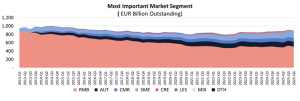
Available ABS data EUR billion for all asset classes
Source: European DataWarehouse
What the GAS Project Delivered
The central outcome of the GAS project is a practical data and research framework for analysing the environmental characteristics of auto securitisations.
A key building block was the development of a dedicated GAS database, created with EDW contribution. This database links auto loan and lease data to vehicle l CO₂ emissions per Km in accordance with the European Enviroment Agency, making it possible to assess environmental performance using measurable indicators rather than proxies.
Using this dedicated dataset, the project produced a series of research outputs that examined:
- How green European auto ABS are when measured using emissions data,
- Investor demand for sustainability related information in auto securitisation,
- Credit risk dynamics linked to the transition towards electric vehicles,
- And the impact of fragmented vehicle labelling systems on transparency and comparability.
It’s important to note that, taken together, these outputs demonstrate that enriching securitisation data with environmental attributes is technically feasible and materially improves the quality of ESG insights available to market participants.
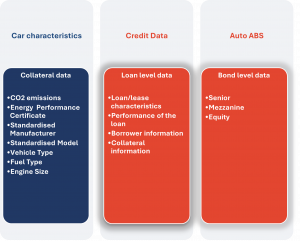
High-level description of the GAS Database
Source: European DataWarehouse
From Research Results to Market Relevance
The GAS project shows that improving ESG transparency in auto securitisation does not require entirely new reporting regimes. Instead, it highlights the value of connecting existing granular data with additional environmental attributes in a consistent and structured way.
For issuers, this approach supports more credible sustainability narratives. For investors, it enables better risk and impact assessment. And for policymakers and supervisors, it provides evidence-based insights into how securitisation can support the green transition without relying on broad assumptions.
From EDW’s perspective, the project reinforces the evolving role of data repositories both as compliant infrastructure, but as platforms that can support applied ESG analysis when underpinned by high quality, standardised data.
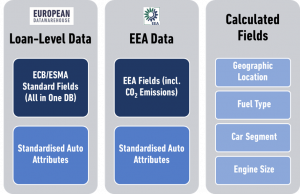
Structure of the GAS Database
Source: European DataWarehouse
What Comes Next
With the research phase now complete, attention turns to application and accessibility.
The findings of the GAS project are set out in the final report, available in German. EDW will also continue to support stakeholders who wish to explore the underlying methodology or understand how similar data enrichment approaches could be applied in practice.
In summary, as expectations around sustainability disclosure continue to rise, the GAS project offers a clear takeaway. ESG insights are most useful when they are grounded in data, comparable across markets and operationally realistic.